GWI COVERS HOW ACURIANT ADVANCES THE FUTURE OF MEMBRANE TECHNOLOGY
Christian Göbbert, CSO and VP of R&D at Acuriant, shares our vision for next-generation ceramic and polymeric membranes in water treatment, as featured in GWI on 24 November 2025.
November 24, 2025
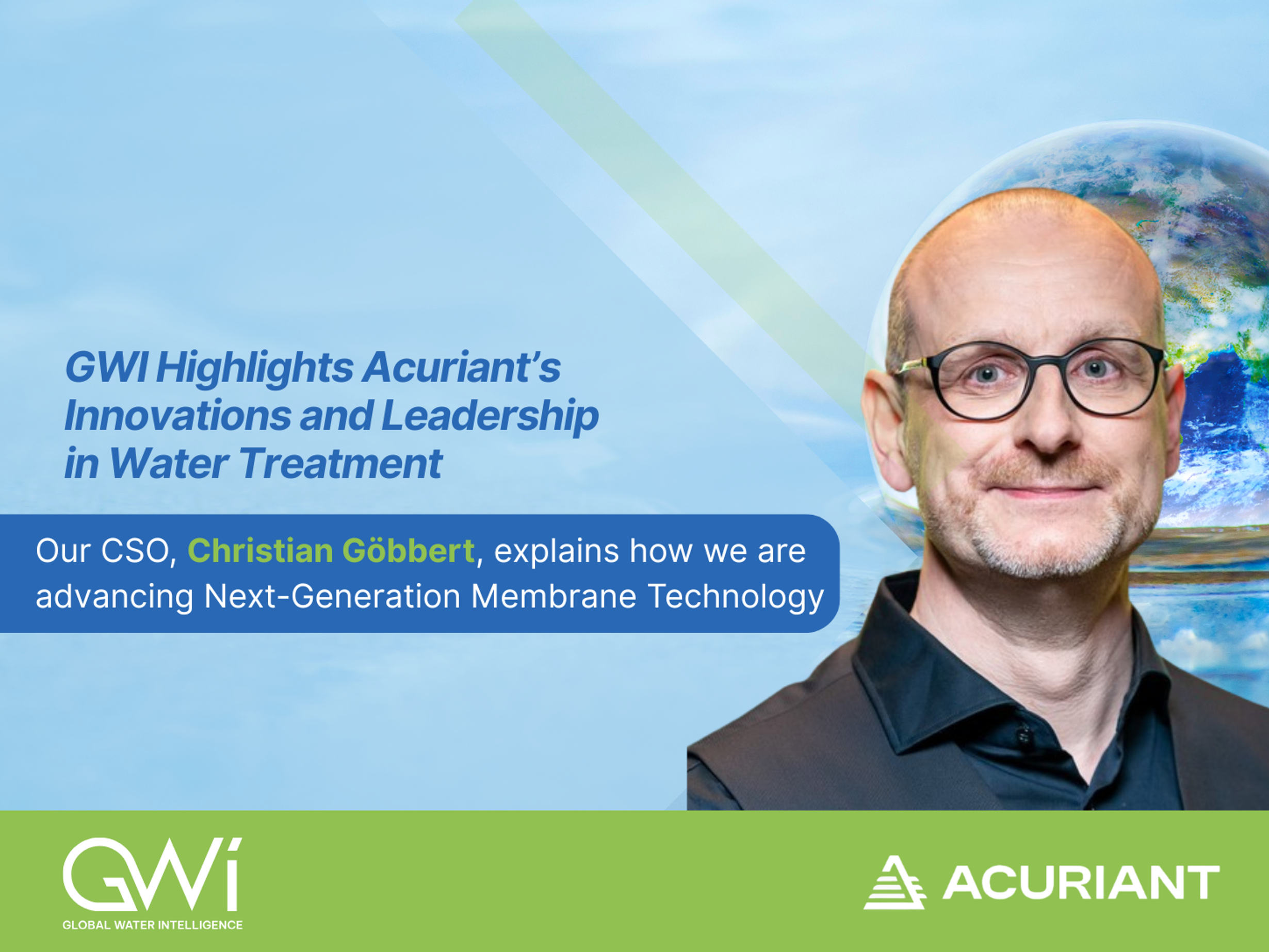
Today, on 24 November 2025, Global Water Intelligence (GWI) published an interview with our Chief Science Officer and Vice President of R&D, Christian Göbbert, highlighting the technological direction and R&D focus of Acuriant following the integration of Nanostone and Solecta.
The merger has created a company with combined expertise in ceramic and polymeric membranes, allowing us to offer a complete membrane-based treatment platform. "Now we can co-optimise pretreatment, UF and RO/NF simultaneously, resulting in better energy efficiency, improved water quality and more robust total system performance. It is a more holistic view on water treatment, not just one particular process step. The advantage for the customer is an optimised system where all components work perfectly together and are almost impervious to raw water variabilities.".
Christian continues to focus on improving membrane fouling behavior, a major limiting factor across membrane systems. With access to both polymeric and ceramic technologies, we are exploring new ceramic material combinations, surface modifications, and hybrid approaches to better control fouling, chemical resistance, and cleanability. We are also investigating pretreatment strategies using natural coagulants such as chitin and selective adsorbents, aiming to reduce reliance on coagulation while maintaining high water quality.
The interview also highlights our work in digitalisation and data-driven optimisation. By analysing long-term pilot and customer data, we can anticipate fouling, adjust cleaning schedules proactively, and model system performance, helping operators optimise energy use and operational efficiency. Future tools will allow users to predict long-term costs, cleaning frequency, and system resilience based on real data.
In terms of market trends, municipal drinking water remains the primary growth area for ceramic membranes, given the variability in water quality and new regulations. Industrial reuse, semiconductor wastewater, and pretreatment for seawater reverse osmosis are also seeing growing adoption. While polymeric membranes dominate by volume, ceramics offer unique advantages, including higher flux, durability in aggressive conditions, and long-term sustainability, particularly as regulations around PFAS evolve.
Sharing insights from our leadership, as in this interview, is important to demonstrate our innovation, technological expertise, and long-term vision for the water industry. By integrating ceramic and polymeric technologies, advancing membrane design, and applying digital intelligence, Acuriant continues to address the evolving challenges of water treatment worldwide.