HOW ACURIANT IS REWRITING THE RULES OF MEMBRANE FILTRATION
Acuriant combines ceramic and polymeric membranes, AI-driven optimisation, and local engineering to deliver sustainable, high-performance filtration solutions.
November 16, 2025
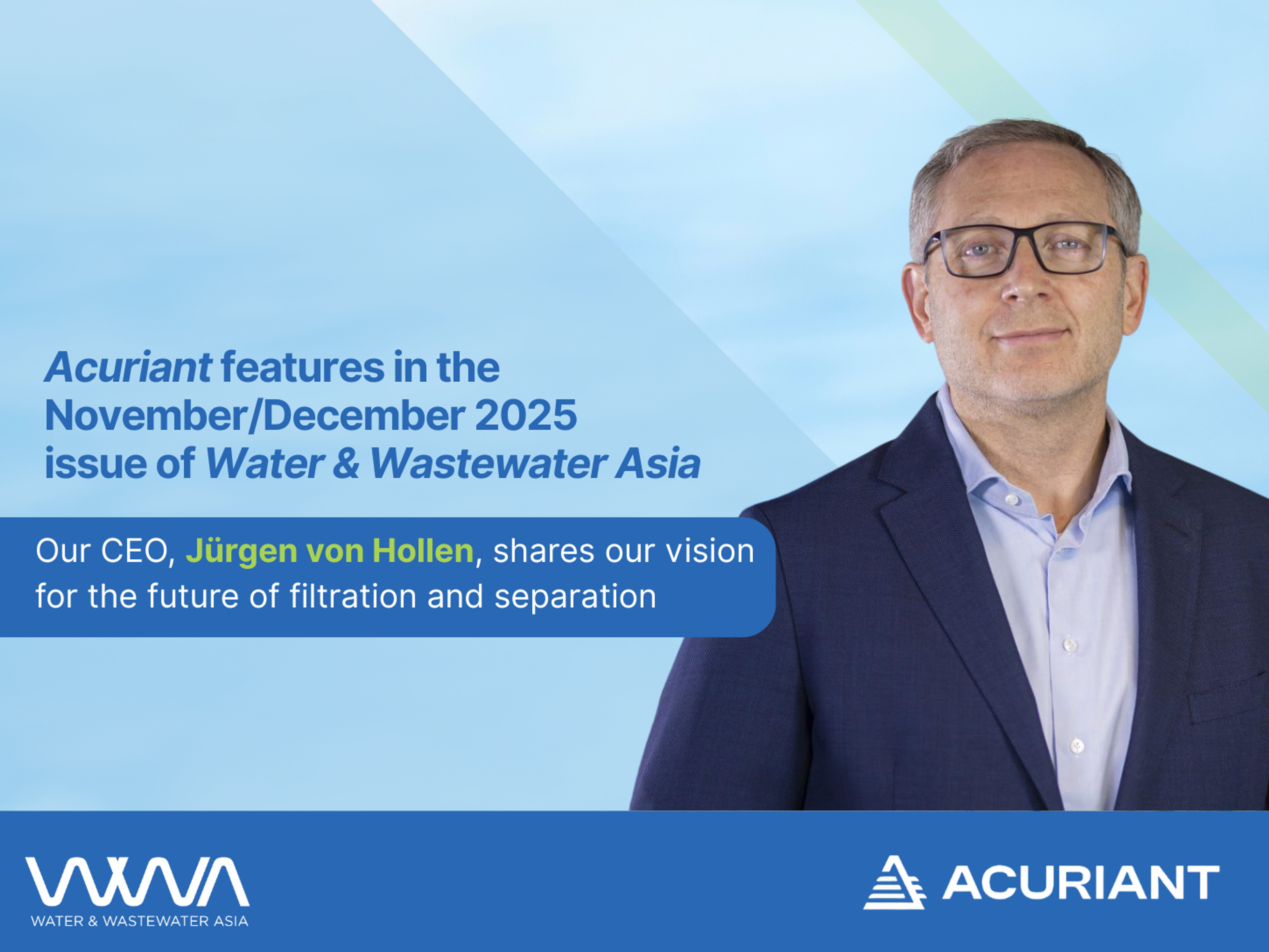
In the November–December edition of Water & Wastewater Asia, our CEO, Jürgen von Hollen, explained how Acuriant Technologies combines the expertise of Nanostone Water and Solecta to deliver comprehensive membrane filtration and separation solutions. The merger expanded our global reach, diversified our technology portfolio, and strengthened field experience, enabling Acuriant to address complex challenges across municipal water, industrial wastewater, and high-precision separation markets such as dairy, food ingredients, and life sciences.
“We don’t see ourselves as a product company, we are a solutions company,” von Hollen told Water & Wastewater Asia. “Once the product is sold, that’s when the work really starts, through optimisation, integration, and ensuring it works over its full lifecycle.”
Solutions-First Approach. Engineering Over Inventory
At Acuriant, we focus on delivering measurable outcomes, not just selling membranes. Our teams map the customer’s process, conduct on-site pilots, and iteratively optimise the system until it achieves consistent, reliable performance.
Key benefits of our approach:
- Comprehensive evaluation of upstream and downstream systems.
- Real-world pilots to validate performance before full-scale deployment.
- Continuous optimisation based on field data.
- Local support and spare parts readiness for fast response.
Ceramic and Polymeric Membranes, Complementary Strengths
Ceramic membranes are exceptionally durable, handling high-solids, abrasive, or chemically aggressive streams such as industrial wastewater, mining effluents, and municipal sidestreams. They also enable higher water recovery per square metre, making them ideal for space-limited facilities.
Polymeric membranes provide precision for ultra-fine separations, essential in dairy, food, and life-science applications. They optimise product yield, stabilise quality, and extend shelf life.
By assessing the entire process, we determine whether ceramic, polymeric, or hybrid solutions deliver the most effective technical and economic outcome.
Data-Driven Innovation & AI
Acuriant leverages over a decade of field data to develop AI-driven membrane optimisation tools. These models help operators identify optimal operating windows, predict maintenance needs, and fine-tune performance.
“Everyone talks about artificial intelligence, but our approach is rooted in specificity. We use our data to understand which technologies work best in which environments,” von Hollen explained.
Performance, Cost, and Sustainability
Sustainability is integral to our engineering approach. By optimising energy use, reducing chemical consumption, and improving water recovery, Acuriant solutions deliver both environmental and economic benefits. Lifecycle-focused design ensures longer membrane life, reduced maintenance, and a smaller operational footprint.
Global Expansion with Local Support
Acuriant applies a strategic heat-mapping approach to prioritise markets where customer need and value creation align. Asia, including India and the Philippines, is a key growth region. Local application engineering, pilot capacity, and service infrastructure allow us to provide timely, contextual support.
“Membrane filtration isn’t a one-time sell. You need to be on the ground to ensure performance over time,” von Hollen emphasized.
Common Questions About Membrane Filtration and Acuriant Solutions
When should I choose ceramic vs polymeric membranes?
When should I choose ceramic vs polymeric membranes?
Choose ceramic for high-solids, abrasive, or chemically aggressive streams. Choose polymeric for ultra-fine separations where yield and product quality are critical.
Does Acuriant conduct on-site pilots?
Does Acuriant conduct on-site pilots?
Yes. We validate performance under real process conditions before full-scale installation.
How does Acuriant use AI to improve membrane performance?
How does Acuriant use AI to improve membrane performance?
We apply data-driven, application-specific models to optimise operating conditions, predict maintenance events, and enhance uptime.
Partnering for Long-Term Outcomes
If you are evaluating membrane filtration technologies, facing yield or footprint constraints, or need an on-site pilot, Acuriant collaborates with customers to co-develop solutions that enhance recovery, efficiency, and total lifecycle performance.
“We don’t push products. We partner with customers to engineer solutions that meet their process realities.”
— Jürgen von Hollen, CEO, Acuriant